 by

Key Takeaways
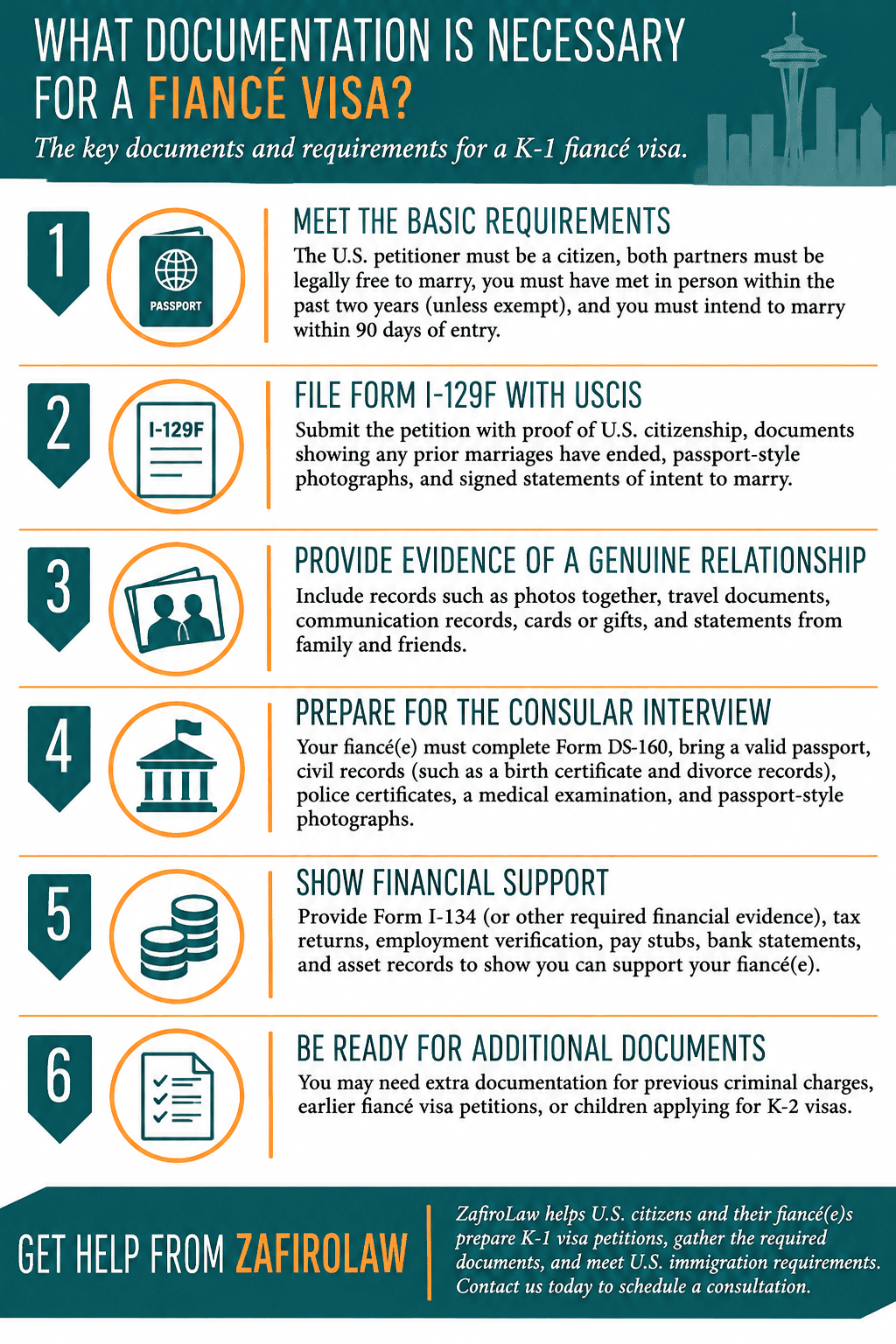
- A K-1 fiancé visa requires proof of U.S. citizenship, legal eligibility to marry, a genuine relationship, and an intention to marry within 90 days of the foreign fiancé(e)’s admission.
- The U.S. citizen must submit Form I-129F with citizenship records, evidence of prior marriage terminations, passport photographs, and proof of intent to marry.
- Couples must document an in-person meeting within the two years preceding their petition unless USCIS grants an exemption.
- The foreign fiancé(e) must prepare Form DS-160, a valid passport, civil records, police certificates, medical examination documentation, and photographs for the consular interview.
- Financial documentation may include Form I-134, tax returns, employment verification, pay stubs, bank statements, and asset records.
- Additional documentation may be needed for previous criminal charges, earlier fiancé visa petitions, or children applying for K-2 visas.
If you’re a U.S. citizen planning to marry someone from another country, you’ll need to submit documentation proving that you both qualify for a K-1 fiancé visa. U.S. Citizenship and Immigration Services (USCIS) will want to see proof of your citizenship, evidence of your relationship, and confirmation that you intend to marry within 90 days of your fiancé(e)’s arrival in the United States. Your fiancé(e) must also provide identification, civil records, and other documentation when applying for the visa at a U.S. embassy or consulate.
At ZafiroLaw in Seattle, Washington, we help couples prepare fiancé visa petitions, gather supporting records, and meet federal immigration requirements. This guide explains what documentation is necessary for a fiancé visa, when you’ll need to submit it, and how to prepare your application for USCIS and the consular interview.
What Is a K-1 Fiancé Visa, and Who Qualifies?
A K-1 fiancé visa allows a foreign national engaged to a U.S. citizen to enter the United States for the purpose of getting married. The marriage must take place within 90 days of the foreign fiancé(e)’s admission. After the marriage, the foreign spouse can apply for lawful permanent resident status through USCIS.
Under Section 214(d) of the Immigration and Nationality Act (INA), you and your fiancé(e) must meet the following criteria:
- U.S. Citizenship: The petitioning partner must be a U.S. citizen. Green card holders aren’t eligible to sponsor a fiancé(e) for a K-1 visa.
- Legal Eligibility to Marry: Both partners must be legally free to marry. Any previous marriages must have ended through divorce, annulment, or the death of a spouse.
- In-Person Meeting: You must have met your fiancé(e) in person at least once during the two years before filing Form I-129F, unless USCIS grants an exemption.
- Intent to Marry: Both partners must intend to marry each other within 90 days of the foreign fiancé(e)’s admission to the United States.
- Genuine Relationship: Your relationship must be genuine, and you must intend to establish a life together as a married couple.
Note: USCIS may waive the in-person meeting requirement if meeting would cause extreme hardship to the U.S. citizen petitioner or violate strict, long-established customs of the foreign fiancé(e)’s culture or social practices. You must provide evidence establishing the grounds for the requested exemption.
What Documents Are Required to File Form I-129F?
The first stage of obtaining a K-1 fiancé visa begins when you submit Form I-129F, Petition for Alien Fiancé(e), to U.S. Citizenship and Immigration Services (USCIS). As the U.S. citizen petitioner, you’re responsible for completing the form and providing documents establishing your eligibility and your intention to marry.
Completed Form I-129F and Proof of U.S. Citizenship
You must submit a completed, signed Form I-129F with the filing fee. USCIS also needs evidence that you’re a U.S. citizen. You can establish citizenship by submitting a copy of one of the following:
- U.S. Birth Certificate.
- An unexpired U.S. passport or passport card issued with a validity period of at least five years.
- Documentation issued by USCIS or the former Immigration and Naturalization Service confirming your naturalization.
- An official certificate establishing your U.S. citizenship.
- Consular Report of Birth Abroad (Form FS-240, issued to qualifying U.S. citizens born outside the United States).
USCIS also accepts a statement from a U.S. consular officer certifying that you’re a U.S. citizen and hold a valid U.S. passport.
Proof That Both Partners Are Legally Free to Marry
If you or your fiancé(e) were previously married, you must provide evidence showing that every previous marriage has legally ended. Acceptable documents include final divorce decrees, annulment orders, and death certificates for deceased spouses.
If either partner has changed their legal name, you must also provide documentation connecting their current name to the name appearing on their records. This may include a marriage certificate, adoption decree, or court order.
Passport-Style Photographs
USCIS needs one recent color photograph of you and one of your foreign fiancé(e). Both photographs must meet the following requirements:
- Measure 2 by 2 inches.
- Have a white or off-white background.
- Show a full, frontal view of the person’s face.
- Have been taken within 30 days before filing Form I-129F.
- Be printed on thin photographic paper with a glossy finish.
Write each person’s name and Alien Registration Number (A-Number), if assigned, lightly on the back of their photograph.
Signed Statements of Intent to Marry
You must provide evidence that you and your fiancé(e) intend to marry within 90 days of their admission to the United States on a K-1 visa. Signed statements from both partners are a common way to establish this intention.
Each statement should identify the person signing it, confirm the couple’s intention to marry each other, and acknowledge the 90-day marriage requirement. USCIS also accepts other evidence establishing your mutual intention to marry.
You must also submit evidence that you’ve met in person within the two years preceding the petition, unless you’re requesting an exemption. We’ll discuss the documents used to establish your relationship in the next section.
What Evidence Proves a Genuine Relationship?
USCIS will want to see evidence that you and your fiancé(e) intend to marry and have met in person within the two years preceding your Form I-129F filing. You should also provide documentation showing that your relationship is genuine and that you intend to establish a married life together.
Evidence That You Met in Person Within the Two-Year Period
You must demonstrate that you and your fiancé(e) met face-to-face at least once during the two years immediately before submitting Form I-129F. Documents establishing the date and location of your meeting include:
- Passport Stamps: Copies of passport pages showing entry into and departure from the country where you met.
- Airline Tickets and Boarding Passes: Travel records confirming trips taken to visit each other.
- Hotel Reservations and Receipts: Documentation showing accommodation arrangements during your visits.
- Dated Photographs: Pictures of you and your fiancé(e) together during visits, accompanied by dates and locations.
- Written Statements: Accounts from you and your fiancé(e) identifying when and where you met in person.
USCIS examines the evidence collectively to determine if you’ve satisfied the meeting requirement. Photographs and personal statements may be insufficient without travel records or other documentation confirming the dates of your visits.
Additional Evidence of an Ongoing Romantic Relationship
Beyond proving that you’ve met in person, you can submit records demonstrating that your relationship is genuine and ongoing. Examples include:
- Messages and Emails: Samples of correspondence showing regular communication throughout your relationship.
- Video Call Records: Call histories documenting communication while you’ve been living apart.
- Photographs With Family and Friends: Pictures showing your involvement in each other’s lives.
- Shared Travel Records: Reservations, tickets, and receipts from trips you’ve taken together.
- Wedding Planning Documents: Venue reservations, correspondence with vendors, and other records showing your plans to marry.
USCIS doesn’t need every document listed above. The evidence you submit should establish the history of your relationship and your mutual intention to marry.
What if You Haven’t Met in Person?
USCIS may waive the in-person meeting requirement under Section 214(d) of the INA if you establish one of two grounds:
- Extreme Hardship: Meeting your fiancé(e) in person would cause extreme hardship to you as the U.S. citizen petitioner.
- Cultural or Social Customs: Meeting before marriage would violate strict, long-established customs of your fiancé(e)’s foreign culture or social practices, and you establish that all aspects of the traditional marriage arrangements have been or will be followed.
You must submit documentation substantiating your waiver request with Form I-129F. USCIS evaluates the evidence before deciding if an exemption is warranted.
What Documents Does Your Fiancé(e) Need for the K-1 Visa Interview?
After USCIS approves Form I-129F, it forwards the petition to the National Visa Center (NVC), which assigns a case number and sends it to the appropriate U.S. embassy or consulate. Your foreign fiancé(e) must then apply for a K-1 visa and attend a consular interview. During the interview, a consular officer reviews their documentation, verifies their eligibility, and determines if the visa can be issued.
Your fiancé(e) must prepare the following documents before the interview.
Form DS-160 and Valid Passport
Your fiancé(e) must complete Form DS-160, Online Nonimmigrant Visa Application, through the U.S. Department of State’s website. After submitting the application electronically, they must print the confirmation page and bring it to their interview.
They must also provide a passport valid for travel to the United States. The passport must ordinarily remain valid for at least six months beyond the intended period of stay, although exemptions exist for citizens of certain countries.
Birth Certificates and Previous Marriage Records
Your fiancé(e) must present an official birth certificate and documents establishing that they’re legally free to marry. Necessary records may include:
- Birth Certificate: An original or certified copy issued by the appropriate civil authority.
- Divorce Decrees: Final divorce records establishing the termination of previous marriages for either partner.
- Annulment Records: Court documents confirming that a previous marriage was annulled.
- Death Certificates: Official records establishing the death of a former spouse.
- Name Change Records: Marriage certificates, court orders, or other documents accounting for changes to legal names, as required by the consulate.
Your fiancé(e) should bring photocopies of their civil records and certified translations when necessary. The documents must come from an issuing authority recognized by the U.S. Department of State.
Police Certificates and Criminal History Records
Applicants aged 16 or older must obtain police certificates documenting their criminal history. The Department of State’s K-1 guidance calls for certificates from the applicant’s current country of residence and countries where they’ve lived for six months or longer since turning 16. If your fiancé(e) has been arrested or convicted of a crime, they may also need certified court records, arrest records, and documents showing how the case was resolved.
Note: Individual embassies and consulates usually have further instructions concerning residence periods, certificate validity, and acceptable records. Your fiancé(e) must follow the guidelines issued by the consulate conducting their interview.
Medical Examination Documentation
Before receiving a K-1 visa, your fiancé(e) must undergo a medical examination performed by a physician authorized by the U.S. embassy or consulate. (Examinations conducted by personal physicians who aren’t authorized for immigration medical examinations don’t satisfy this rule.) The physician may send the findings directly to the consulate or provide them in a sealed envelope that your fiancé(e) must bring to the interview.
K-1 applicants don’t have to complete the immigrant visa vaccination requirements before visa issuance. However, vaccination documentation becomes relevant when applying for a green card after marriage.
Passport Photographs and Updated Relationship Evidence
As we mentioned earlier, your fiancé(e) must bring two identical, recent color photographs measuring 2 by 2 inches. The photographs must comply with the Department of State’s visa photograph guidelines.
What Financial Documents Are Necessary for a Fiancé Visa?
During the K-1 visa interview, your fiancé(e) must demonstrate that they’re unlikely to become a public charge in the United States. The consular officer reviews evidence of your fiancé(e)’s financial resources and your ability to support them after their arrival. You may need to provide financial records establishing your income, employment, and available assets.
Form I-134, Declaration of Financial Support
The consular officer may require you, as the U.S. citizen petitioner, to complete Form I-134, Declaration of Financial Support. This form documents your commitment and ability to provide financial assistance to your fiancé(e).
Financial documents you may need include:
- Federal income tax returns
- Employment verification letter
- Recent pay stubs
- Bank statements
- Evidence of savings, investments, or other assets available to support your fiancé(e).
For Form I-134, the U.S. Department of State identifies an income benchmark of 100% of the federal poverty guidelines. The consular officer also evaluates the financial evidence when determining your fiancé(e)’s eligibility.
What Other Documents May Be Required for a Fiancé Visa?
Some K-1 visa applications need documentation beyond the standard identification, relationship, and financial records. This may be the case if you have previous criminal charges, earlier fiancé visa petitions, or children accompanying your fiancé(e).
Previous Criminal Charges or Convictions
Under the International Marriage Broker Regulation Act (IMBRA), U.S. citizen petitioners must disclose convictions for certain crimes and qualifying protection or restraining orders. These include domestic violence offenses, sexual offenses, and other crimes identified in the Form I-129F instructions.
If you have a criminal history that falls within these disclosure rules, USCIS requires documents such as:
- Records identifying criminal charges and showing how each case was resolved.
- Certified documentation of arrests involving offenses listed in the petition instructions.
- Court documents identifying convictions and sentences.
- Records relating to protection and restraining orders issued against you.
Note: You must disclose qualifying offenses even if the records have been sealed or expunged. USCIS shares information about the petitioner’s qualifying criminal history with the Department of State for disclosure to the foreign fiancé(e).
Previous Fiancé Visa Petitions
IMBRA also limits repeated fiancé visa petitions. You must request a filing waiver if:
- You’ve previously filed Form I-129F petitions for two or more fiancé(e) beneficiaries.
- You’ve had a previous Form I-129F approved, and less than two years have passed since that petition was filed.
A waiver request must explain why USCIS should permit another petition and include documentation supporting your request.
Children Applying for K-2 Visas
If your foreign fiancé(e) has unmarried children under age 21, they may qualify for K-2 visas to accompany or follow their parent to the United States. Each child applying for a K-2 visa must have their own visa application and supporting documents, including:
- Form DS-160: A separate online visa application and confirmation page.
- Valid Passport: A passport meeting U.S. visa guidelines.
- Birth Certificate: An official record establishing the child’s identity and parentage.
- Medical Examination: Examination records from an authorized physician.
- Custody or Parental Consent Records: Documents establishing permission for the child to relocate when required by the laws of the child’s country or consular instructions.
Questions? Speak to a Seattle Family and Immigration Lawyer
At ZafiroLaw, we help U.S. citizens and their foreign fiancé(e)s prepare K-1 visa petitions and supporting documentation. Our Seattle immigration attorneys can review your eligibility, identify the records you need, prepare your petition, and help you address questions from USCIS or the U.S. embassy or consulate. For more information or to schedule a no-obligation consultation, please call (206) 309-9645 now.